You are managing a career, a aging parent, children who still need you, and a household that doesn't run itself. You are doing the work of three people and calling it Tuesday.
So when someone tells you to "upskill in AI" or "future-proof your career," I need you to hear what I'm actually saying to you. Not the noise. Not the LinkedIn advice written by someone with nothing but time.
This.
The data is out. The research is in. And if nobody has sat you down and told you the truth yet, consider this your intervention.
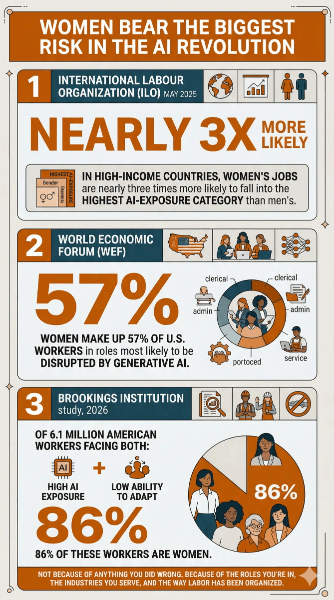
Women are carrying the biggest risk in the AI revolution. Not because of anything you did wrong. Because of the roles you're in, the industries you serve, and the way labor has been organized for the last 50 years. The International Labour Organization confirmed it in May 2025: in high-income countries, women's jobs are nearly three times more likely to fall into the highest AI-exposure category than men's. The World Economic Forum added that women make up 57% of US workers in roles most likely to be disrupted by generative AI.
And a Brookings Institution study published this year found something that stopped me cold. Of the 6.1 million American workers facing both high AI exposure and low ability to adapt, 86% are women.
86%.
So yes. Women are the most affected. And no, it is not your fault. But that does not mean you get to wait.
This Is What's Actually Happening
The roles carrying the most risk are not obscure. They are the backbone of every organization you have ever worked in.
Administrative assistants. Customer service. Bookkeeping and payroll. HR coordination. Healthcare administration. Middle management coordination. Legal support. Insurance processing. These are the roles where decades of skilled, experienced women have built careers. Where women 40 and over have quietly become indispensable.
And they are the exact roles AI is targeting first.
This is not speculation. Microsoft 365 Copilot is already handling scheduling, email drafts, meeting summaries, and expense reports. AI chatbots are managing first and second-tier customer service at scale. Automated systems are processing insurance claims, flagging HR applications, and drafting legal documents. Bookkeeping software now reconciles, categorizes, and flags anomalies without a human touching it.
The question is not whether this is happening. It is happening. The question is whether you are going to be the person who manages it or the person it happens to.
The Harder Truth Nobody Is Saying Out Loud
Here is what makes this particularly unfair.
You are already stretched. The research shows it. McKinsey estimates women carry 200 extra hours per year of unrewarded "office housework" at work. At home, women in the sandwich generation are managing the logistics of aging parents while still being the primary emotional anchor for their children. You have been running at full capacity for years.
And now the world is asking you to add one more thing.
I hear you. I see the absurdity of it. You are not wrong to feel that the timing is brutal.
But I need you to hear this the way I mean it: the women who act now are not the women with the most time. They are the women who decided their future was worth 30 minutes a day. That is the whole gap. Thirty minutes, repeated consistently, over six months.
You already have everything else.
Here Is What Nobody Is Telling You About Your Brain
The narrative about AI says the advantage goes to the young. The fast learners. The ones who grew up digital.
The research says something completely different.
A 2025 study published in the journal *Intelligence* analyzed 16 dimensions of cognitive and personality performance across all age groups. Their finding: overall human functioning peaks between ages 55 and 60. Not 25. Not 35. Fifty-five to sixty.
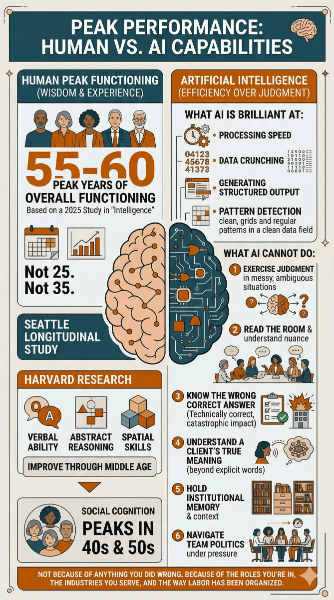
What AI is brilliant at: processing speed. Data crunching. Generating structured output at scale. Pattern detection in clean, organized information.
What AI cannot do: exercise judgment in messy, ambiguous, high-stakes situations. Read the room. Know when the answer is technically correct but organizationally catastrophic. Understand what a client really means, not just what they said. Hold institutional memory. Navigate the unspoken politics of a team under pressure.
That is your territory. That has always been your territory. And right now, that territory is worth more than it has ever been.
MIT economist Daron Acemoglu, who won the Nobel Prize in Economics in 2024, puts it plainly: AI is being deployed too heavily for automation and not enough for providing expertise and information to workers. The skills that can't be automated are the ones that grow with experience. You have been building them for decades.
Your Move. Right Now.
This is not a motivational close. This is a tactical briefing.
First: Stop treating AI like something you need to understand. Start treating it like a new hire you are managing.
You do not need to know how the engine works to drive the car. You need to know how to direct it, evaluate its output, and catch it when it's wrong. AI makes confident mistakes. It hallucinates. It produces plausible-sounding nonsense with complete authority. The skill the market is paying for is not building AI. It is the judgment to know when AI's output can be trusted and when it cannot.
That skill? You already have the foundation. You have spent your career developing judgment. Now you apply it here.
Second: Start with what is already in your hands.
If you use Microsoft 365 at work, Copilot is already there or coming. If you use Google Workspace, Gemini is already integrated. Your CRM, your project management tool, your HR software — AI features are being activated across all of it. Do not wait for a course. Open the tool you use most and find the AI feature. Use it once today. Evaluate the output. That is your first move.
Third: Name what you are doing.
This is the step most women skip, and it is the most strategically important one. When you use AI to improve something at work, say so. Write it in your next performance review. Put it on your LinkedIn profile. Skills in AI literacy are now the fastest-growing skills category on LinkedIn. Roles that advertise AI capabilities command a 56% wage premium, according to PwC's 2025 Global AI Jobs Barometer.
You are not bragging. You are making yourself visible in a market that is actively looking for exactly what you are building.
Fourth: Commit to 30 minutes a week minimum.
Not daily. Not a bootcamp. Not a full course right now. Thirty minutes a week, directed and intentional. Try one AI tool. Write one prompt. Evaluate one output. BCG research found that senior women in tech who engaged with generative AI led their male counterparts in adoption by 12 to 16 percentage points. They did not have more time than you. They made a decision.
Fifth: Understand what you are protecting.
You are not learning AI to prove something. You are not doing this to impress anyone. You are doing this because you have spent decades building something — a career, a reputation, a set of skills that organizations genuinely need. AI is not here to erase that. But it will revalue it, fast, in favor of the people who know how to use it.
The women who will thrive in the next ten years are not the most technical. They are the most strategically adaptive. They are the ones who brought 20 years of judgment and domain expertise to a new set of tools and became exponentially more valuable overnight.
That is available to you. Right now. Starting this week.
You are doing the most with the least margin of anyone I know. The sandwich generation is real. The mental load is real. The exhaustion is real.
And you are still here, reading this, which means some part of you already knows: this matters.
Not because the world deserves more from you. It doesn't. You have given enough.
Because *you* deserve to be the one who chooses what comes next. Not the organization. Not the technology. Not the market.
You,
That starts with one move. Make it today.
*Sources: International Labour Organization, Working Paper 140 (May 2025); World Economic Forum, Gender Parity in the Intelligent Age (March 2025); Brookings Institution/NBER Working Paper 34705 (January 2026); Gignac & Zajenkowski, Intelligence (October 2025); Harvard Gazette / Hartshorne & Germine (2015); PwC Global AI Jobs Barometer (June 2025); BCG, Women Leaders in GenAI (May 2024); McKinsey, Women in Tech and AI in Europe (March 2026); Microsoft/LinkedIn Work Trend Index (May 2024).